“प्राणस्य प्राणः” (“pranasya pranah”). “Breath of breath:”
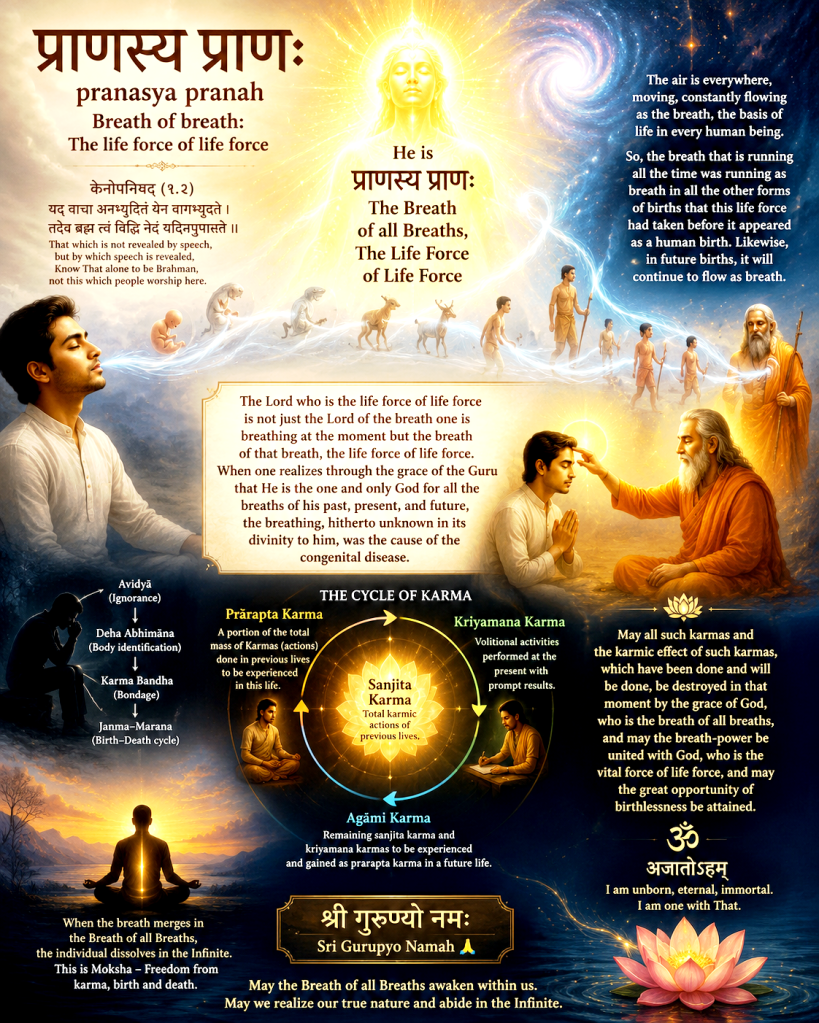
The Kena Upanishad (1.2) contains a profound philosophical concept known as “pranasya pranah” (“प्राणस्य प्राणः”).
In Sanskrit, it literally translates to “breath of breath” or “the vital force of life force.”
The air is everywhere, moving, constantly flowing as the breath, the basis of life in every human being. So, the breath that is running all the time was running as breath in all the other forms of births that this life force had taken before it appeared as a human birth. Likewise, in future births, it will continue to flow as breath also.
That is, “the Lord who is the life force of life force” is not just the Lord of the breath one is breathing at the moment but the breath of that breath, the life force of life force. When one realizes through the grace of the Guru that He is the one and only God for all the breaths of his past, present, and future,
The breathing, hitherto unknown in its divinity to him, was the cause of the congenital disease.
Sanjita Karma: Total karmic actions of previous lives.
Prārapta Karma = A portion of the total mass of Karmas (actions) done in previous lives to be experienced in this life.
Kriyamana Karma = Volitional activities performed at the present with prompt results.
Agāmi Karma = Remaining sanjita karma and kriyamana karmas to be experienced and gained as prarapta karma in a future life.
May all such karmas and the karmic effect of such karmas, which have been done and will be done, be destroyed in that moment by the grace of God, who is the breath of all breaths, and may the breath-power be united with God, who is the vital force of life force, and may the great opportunity of birthlessness be attained.
Sri Gurupyo Namah 🙏


