Whose ego can surrender?
Ramana Maharishi says:
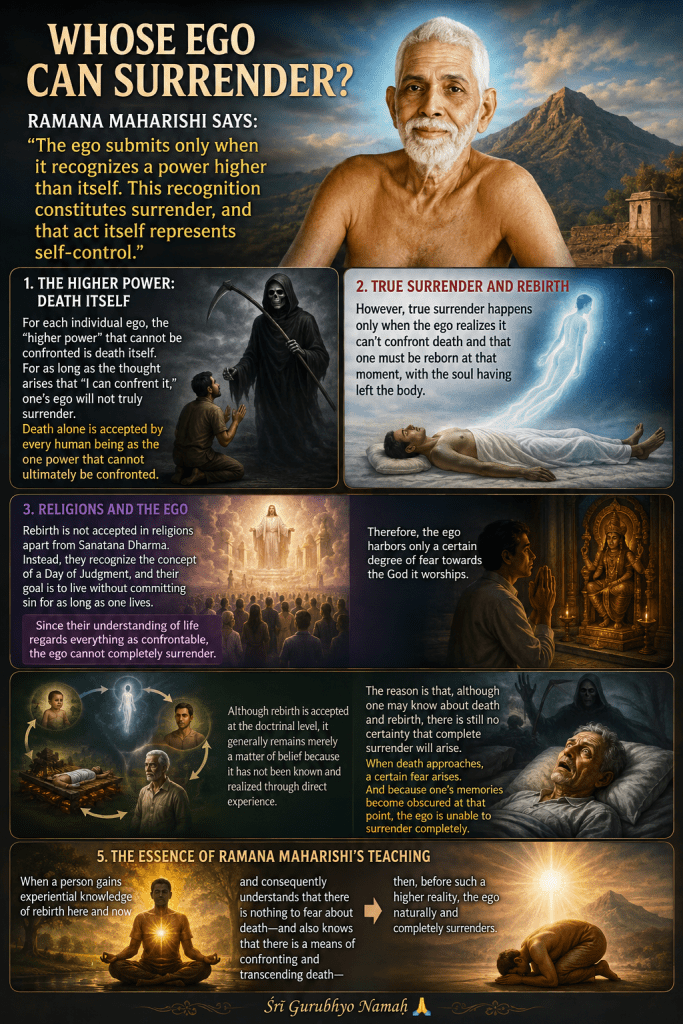
“The ego submits only when it recognizes a power higher than itself. This recognition constitutes surrender, and that act itself represents self-control.
For each individual ego, the “higher power” that cannot be confronted is death itself. For as long as the thought arises that “I can confront it,” one’s ego will not truly surrender. Death alone is accepted by every human being as the one power that cannot ultimately be confronted.
However, true surrender happens only when the ego realizes it can’t confront death and that one must be reborn at that moment, with the soul having left the body.
However, rebirth is not accepted in any religion apart from Sanatana Dharma. Instead, the other religions generally recognize the concept of a Day of Judgment, and their goal is to live without committing sin for as long as one lives. Therefore, since their understanding of life regards everything as confrontable, the ego cannot completely surrender. In contrast, the ego harbors only a certain degree of fear towards the God it worships.
Even within Sanatana Dharma, although rebirth is accepted at the doctrinal level, it generally remains merely a matter of belief because it has not been known and realized through direct experience. The reason is that, although one may know about death and rebirth, there is still no certainty that complete surrender will arise. Instead, when death approaches, a certain fear arises. And because one’s memories become obscured at that point, the ego is unable to surrender completely.
Therefore, the essence of Ramana Maharishi’s teaching is this:
When a person gains experiential knowledge of rebirth here and now and consequently understands that there is nothing to fear about death—and also knows that there is a means of confronting and transcending death—then, before such a higher reality, the ego naturally and completely surrenders.
Śrī Gurubhyo Namaḥ 🙏


