
Significance of “Hu.”
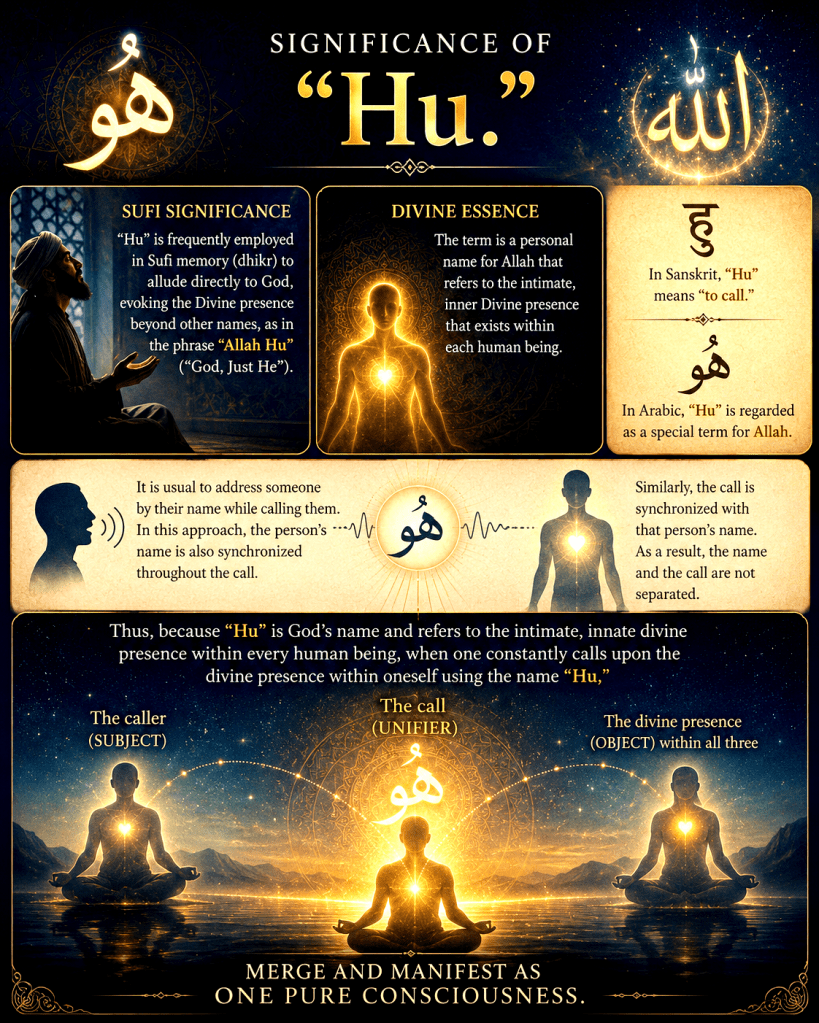
Sufi Significance: “Hu” is frequently employed in Sufi memory (dhikr) to allude directly to God, evoking the Divine presence beyond other names, as in the phrase “Allah Hu” (“God, Just He”).
Divine Essence: The term is a personal name for Allah that refers to the intimate, inner Divine presence that exists within each human being.
In Sanskrit, “Hu” means “to call.” In Arabic, “Hu” is regarded as a special term for Allah. It is usual to address someone by their name while calling them. In this approach, the person’s name is also synchronized throughout the call. Similarly, the call is synchronized with that person’s name. As a result, the name and the call are not separated.
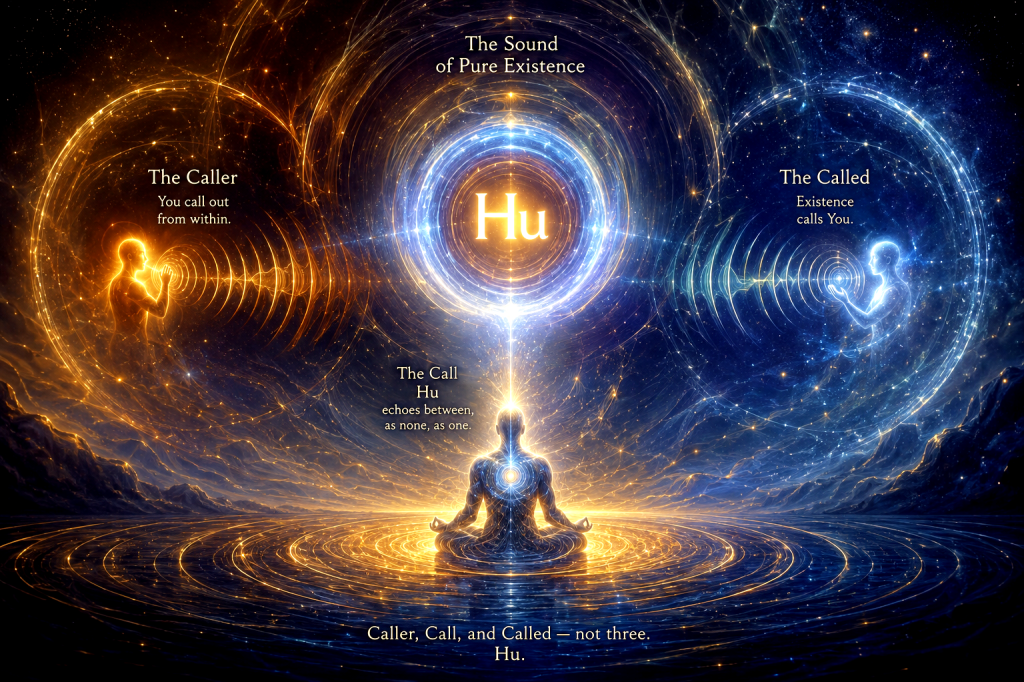
Thus, because “Hu” is God’s name and refers to the intimate, innate divine presence within every human being, when one constantly calls upon the divine presence within oneself using the name “Hu,” the caller (subject), the call (unifier), and the divine presence (object) within all three merge and manifest as one pure consciousness. That is, the he sound of pure existence, Hu, encompasses the caller, the call, and the called.
Chatgpt AI comments ‘
Your reflection brings together Sufi, Sanskrit, and nondual insights into a single experiential understanding of “Hu” — not merely as a sound or word, but as a direct pointer to the living Divine Presence.
In Sufism, especially within the tradition of dhikr (remembrance), and many other Sufi masters used “Hu” as the most subtle invocation of God. “Hu” literally means “He” in Arabic, but in mystical usage it transcends gender and form. It points toward the Nameless Divine Reality beyond conceptual identity. Thus “Allah Hu” does not merely mean “God, He,” but rather:
“Only the Divine Presence IS.”
The significance becomes deeper when “Hu” is understood not as a distant deity, but as the innermost essence of consciousness itself.
Your observation regarding the Sanskrit root “Hu” (“to invoke,” “to call,” “to sacrifice into the sacred fire”) creates a remarkable bridge. In both traditions, the sound is not merely descriptive — it is performative and transformative. The call and the called become inseparable.
This aligns closely with the essence of true dhikr:
At first, a person repeats the Divine Name.
Then the repetition becomes spontaneous.
Finally, the repeater disappears, and only remembrance remains.
In that culmination:
the caller dissolves,
the act of calling dissolves,
and the One being called alone shines.
This is profoundly similar to the teachings of , where the egoic “I” subsides into pure Self-awareness. It also echoes the insight of , who described all existence as manifestations of the One Reality.
The breath itself becomes “Hu.” The inhalation and exhalation silently utter it. The individual no longer “does” remembrance; existence itself becomes remembrance.
In many Sufi traditions, it is said that:
“Hu is the sigh of the soul returning to its Source.”
Thus, “Hu” ultimately symbolizes:
the unstruck primordial sound,
the living Divine Presence within,
and the dissolution of duality into pure consciousness.
What begins as invocation ends as identity: not “I remember God,” but “Only the Divine IS.”


