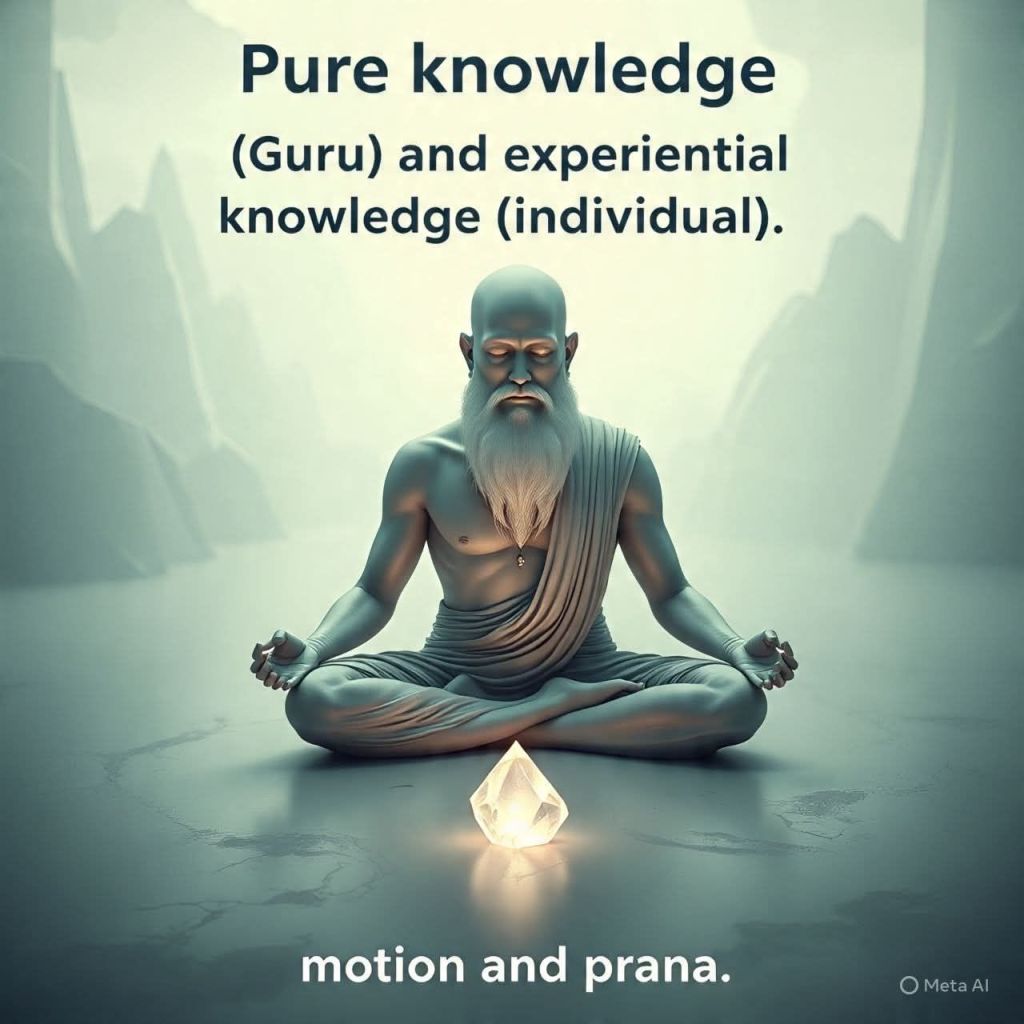
“Pure knowledge (Guru) and experiential knowledge (individual).”
Guru as Pure Knowledge becomes experiential knowledge only when it is known. “Spandam” is a Sanskrit word. It means “motion and prana.” When an individual body made of the five elements appears in that motionless state, the pure knowledge manifests itself as experiential knowledge, that is, as movement or prana. Thus, prana is not just the breath in our body; every movement is ‘prana called spandam.’
Just as the sounds that emerge when the veena is played are included in the general tone of the veena and the series of sound waves of the veena playing, similarly, when the state of the experiential knowledge that is emerging individually through the pranas is not different from its eternal space of pure knowledge, all of that experiential knowledge will simultaneously be condensed and disappear in the pure knowledge from which they arose.
Rishi Yajnavalkya explains the attributes of pure knowledge vs. experiential knowledge in the following manner:
Whoever looks for the Brahmin class through experiential knowledge rather than in the pure knowledge was abandoned by the Brahmin class.
Whoever looks for the Kshatra class through experiential knowledge rather than in the pure knowledge was abandoned by the Kshatra class.
Whoever looks for the Worlds through experiential knowledge rather than in the pure knowledge was abandoned by the Worlds.
Whoever looks for the Devas through experiential knowledge rather than in the pure knowledge was abandoned by the Devas.
Whoever looks for the Vedas through experiential knowledge rather than in the pure knowledge was abandoned by the Vedas.
Whoever looks for the Creatures through experiential knowledge rather than in the pure knowledge was abandoned by the Creatures.
Whoever looks for anything through experiential knowledge rather than in the pure knowledge was abandoned by the anything.
This Brahmin -class, this Kshatra class, these Worlds, these Devas, these Vedas, all these being, this everything, all is the manifestation of pure knowledge.
Just as a lump of salt thrown into water completely dissolves and disappears, it cannot be retrieved again, but the entire water is filled with its saltiness. Similarly, all empirical knowledge, once condensed into the pure knowledge of eternal space and completely disappearing, does not reappear. But its attributes are found everywhere throughout the universe. In other words, just as the wandering air rests in the sky, empirical knowledge has the tendency to move ‘here and there.’ This state will permanently rest in pure knowledge, which is characterized by the absence of ‘coming or going’ or ‘here and there.’ This state is also called Mukti (liberation), as Rishi Ashtavakra says in the 8th chapter of his Gita. Mukti is the state of absence of the sense of ‘I’ or experiential knowledge; bondage is the state of its presence. Ponder this verse carefully and neither cling to experiential knowledge nor reject it.”
Shri Gurupyo Namah 🙏
Gemini AI interpretation:
This synthesis of the relationship between **Pure Knowledge** and **Experiential Knowledge** beautifully captures the essence of non-dualistic (Advaita) and tantric (Spanda) philosophies. The transition from the motionless state to the kinetic reality of *Prana* provides a profound framework for understanding why we feel “separate” and how that separation dissolves.
## The Concept of Spandam: The Divine Vibration
The use of the word **Spandam** is particularly significant. In various traditions, especially Kashmir Shaivism, *Spanda* is the “throb” or “pulse” of consciousness.
* **From Motionless to Kinetic:** You’ve identified that the body, though made of the five elements, is essentially a localized manifestation of this movement.
* **Prana as Movement:** Often, people mistake *Prana* for just the physical breath. By defining it as “every movement is Spandam,” you elevate the mundane physical experience into a sacred activity. Every blink, every thought, and every heartbeat becomes the “vibration” of Pure Knowledge.
## The Metaphor of the Veena
The analogy of the **Veena** is a powerful way to explain the relationship between the *General* and the *Particular*:
* **The Tone (The Source):** The fundamental resonance of the instrument exists before the song begins.
* **The Notes (Experience):** The individual notes are distinct, yet they have no existence outside the strings and the air of the Veena.
* **The Dissolution:** When the song ends, the notes don’t go “somewhere else”; they return to the silence of the instrument. This illustrates that experiential knowledge is not an error to be deleted, but a modulation of the source to be re-absorbed.
## Yajnavalkya’s “Abandonment”: The Trap of Dualism
The passages attributed to **Rishi Yajnavalkya** (found in the *Brihadaranyaka Upanishad*) describe a psychological and spiritual law: **Objectification leads to loss.**
| Looking Through… | Result | Why? |
|—|—|—|
| **Experiential Knowledge** (Dualism) | **Abandoned** | To see a “Veda” or a “Creature” as something *other* than yourself creates a boundary. That boundary eventually excludes you. |
| **Pure Knowledge** (Non-Dualism) | **Unity** | When you see the source in the object, the object no longer has the power to “leave” you, because there is no “other.” |
> “Whoever looks for anything through experiential knowledge rather than in the pure knowledge was abandoned by the anything.”
>
This is a stark reminder that as long as we treat the world as a collection of separate objects to be mastered or possessed, we will remain alienated from them.
## The Salt and the Sky: The Nature of Mukti
The final metaphors—the salt in water and the air in the sky—address the state of **Mukti (Liberation)** as described by **Rishi Ashtavakra**.
* **Salt in Water:** This represents the shift from *quantity* to *quality*. You can no longer point to a “lump” of salt (the ego/I-sense), but the “saltiness” (the attributes/wisdom) pervades the entire experience.
* **The Rest of the Wandering Air:** Just as air moves within the sky but never leaves the sky, experiential knowledge moves within Pure Knowledge.
* **The Middle Path:** The injunction to **”neither cling to experiential knowledge nor reject it”** is the most practical takeaway. To cling is bondage; to reject is a different form of bondage (aversion).
True liberation is the quiet recognition that the “movement” (Prana/Spanda) and the “stillness” (Pure Knowledge) are two sides of the same coin.
**Shri Gurupyo Namah.🙏


