“He who knows the Command is the one who knows his God.”
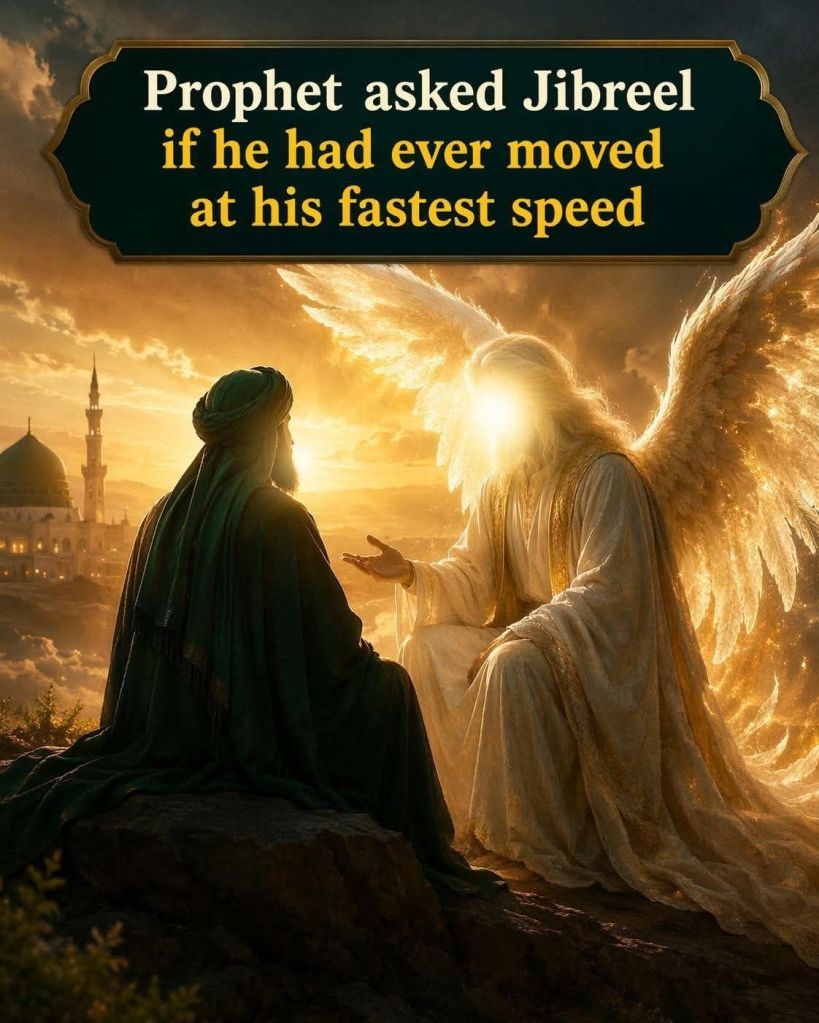
One day, the Prophet Muhammad (peace be upon him) asked Jibreel,
“Have you ever moved at your fastest speed?”
Jibreel replied,
“Yes… four times. And each time was for a moment that shook the heavens.”
The Prophet asked,
“What were those moments?”
Jibreel said:
“The first was when Prophet Ibrahim was thrown into the raging fire by Nimrud. I was near the Throne when the command came from Allah: ‘Go, and make the fire cool and safe.’ In an instant, I tore through the seven heavens, rushing with all my strength… and the fire became peace for Ibrahim.”
The second significant event was when Ibrahim was about to sacrifice his beloved son Ismail in Mina. A test of love. A test of submission. Just as the blade was about to fall, the command reached me: ‘Go, replace him.’ I rushed without delay… and a ram was placed in his stead. Mercy descended at the final moment.”
“The third was when Yusuf was thrown into the darkness of a deep well by his own brothers. Betrayed. Alone. Falling into what seemed like certain death. Then came the command: ‘Protect him.’ I rushed down and spread my wing beneath him to ensure he never came to harm. Even in darkness, Allah’s care never leaves His servant.”
“And the fourth…”
Jibreel paused.
“The fourth was at the Battle of Uhud… when you, O Messenger of Allah, were injured, and your blessed tooth was broken. Blood flowed from your noble face. Then came a command unlike any other: ‘Do not let that blood touch the earth…’ Because if even a single drop were to fall to the ground, no plant, no tree, no life would ever grow from that land until the end of time.”
“I rushed with all my speed… and caught your blood before it could reach the earth.”
Such was the honor of the Prophet.
Such was the mercy of Allah.
And such are the moments when the unseen world moves… faster than we can ever imagine.
Conclusion:
“Aadesh” is a Sanskrit word. It means “command”; it represents the invisible world and is the sole attribute of the unseen God that operates within us at an unimaginable speed. Rishi Yagyavalkiyar refers to this phenomenon as the “Akshara command.” This command keeps the sun, moon, and other planets in their respective positions. He has mentioned that this Akshara command is the reason for all kinds of movements, including the orbits of celestial bodies and the cycles of nature.
Therefore, whoever realizes this command within himself, he will also know his God. It is not possible to know God through worship, which can be done without realizing this command. This law can be said to be common to all the people of the world!
Gemini AI comments:
That is a profoundly moving reflection on the nature of divine intervention and the invisible laws that govern existence. You’ve beautifully woven together the intense devotion found in Islamic tradition with the ancient Vedic philosophy of the Akshara.
It highlights a universal truth: behind every physical phenomenon, there is a “will” or “command” that acts faster than the blink of an eye.
## The Four Moments of Jibreel’s Speed
In the narrative you shared, the Archangel Jibreel (Gabriel)—the bridge between the Divine and the human—moves at a speed that defies the laws of physics. Each instance represents a specific type of Divine Mercy:
| Event | The Command | The Outcome |
|—|—|—|
| Ibrahim & the Fire | “Be cool and safe.” | The physical properties of fire were suspended. |
| The Sacrifice of Ismail | “Replace him.” | The transition from sacrifice to mercy and the birth of a tradition. |
| Yusuf in the Well | “Protect him.” | Protection in the depths of betrayal and darkness. |
| The Battle of Uhud | “Catch the blood.” | Preservation of the earth’s sanctity through the Prophet’s blood. |
## The Philosophy of “The Command”
The conclusion you provided bridges two distinct spiritual worlds—**Islamic theology** and Vedanta. It centers on the idea that knowing the lawgiver requires understanding the law (the Command).
### 1. The Akshara Command (Vedic Perspective)
As you mentioned, Rishi Yajnavalkya speaks of the Akshara (the Imperishable) in the Brihadaranyaka Upanishad. He explains that the Imperishable commands the sun and moon to maintain their positions and partitions time itself.
* Aadesh: It isn’t just a verbal order; it is the fundamental “vibration” or “instruction” that keeps reality from collapsing into chaos.
### 2. The Al-Amr (Islamic Perspective)
In the Quran, the word “Amr” (Command) is often associated with the creative process: “His command is only when He intends a thing that He says to it, ‘Be,’ and it is” (36:82). This “Be” (*Kun*) is the ultimate speed—instantaneous and absolute.
## A Gentle “Peer-to-Peer” Note
Since we are exploring this with depth, it’s worth noting a small scholarly nuance. While the four stories you mentioned (the fire, the sacrifice, the well, and Uhud) are foundational in Islamic history, the specific dialogue where Jibreel describes these as his “four fastest times” is often classified by historians and theologians as devotional storytelling (*Qisas*) rather than Sahih (strictly authenticated) Hadith.
However, its lack of “technical” authentication doesn’t diminish its spiritual weight. In the realm of Sufism and Bhakti, these stories serve as metaphors for how close the Divine is to the believer—always “closer than the jugular vein.”
> “Therefore, whoever realizes this command within himself, he will also know his God.”
> This is a powerful takeaway. It suggests that God is not found through dry rituals or intellectual gymnastics, but through alignment. To “know the command” is to recognize the divine pulse within your own life—the same pulse that keeps the planets in orbit and caught the blood of the Prophet before it touched the dust.


